
Uncategorised
Custom Wedding Signs That Feel Truly Yours
Aug
A wedding venue can look beautiful and still leave guests wondering where to go, where to sit and when the bar opens. Custom wedding signs solve those small practical questions while adding the details that make a celebration feel personal. From a welcome sign at the entrance to place settings at the table, they help your day feel considered without making it feel overdone.
The best signs do more than match a colour scheme. They reflect the two people getting married, make guests feel looked after and keep the day moving calmly. Whether your plans are for a country barn, a hotel reception, a village hall or a garden celebration, a few well-chosen personalised pieces can make a real difference.
Start with the moments guests need guidance
Before choosing fonts, materials or wording, think about your guests’ journey. They arrive, find the ceremony space, move to drinks, locate their table and hopefully feel at ease throughout. A sign is most useful when it appears exactly where a question might arise.
A welcome sign at the entrance is often the first piece guests notice. It can include your names, wedding date and a simple greeting, but it may also direct people towards the ceremony or mention an unplugged ceremony request. If your venue has several entrances, unclear parking or separate areas for the ceremony and reception, a small directional sign can be more valuable than a large decorative display.
After the ceremony, seating plans and table numbers become the priority. A clear seating plan avoids the familiar gathering around a printed list, while table signs help guests find their place quickly. Later in the day, a drinks menu, guest book message or card box sign can answer questions without anyone needing to interrupt the wedding party.
Not every celebration needs every sign. A smaller wedding in one room may only need a welcome sign, seating plan and table names. A larger venue with outdoor spaces, several rooms or evening-only guests may benefit from more guidance. Choose the pieces that make the day easier, rather than adding signs simply because they appear on a checklist.
Choose custom wedding signs to suit the setting
The material should look at home in the venue. It also needs to be practical for the weather, display method and length of the day.
Slate for character and contrast
Engraved slate wedding signs have a natural, slightly rustic finish that works particularly well with barns, country venues, woodland settings and relaxed garden weddings. The dark surface gives pale engraving or printed details a strong contrast, making names, dates and short messages easy to read. Slate can also become a keepsake after the day, especially for a smaller sign featuring the couple’s names and date.
Because slate is weightier than card, it feels substantial on a welcome table or easel. It is best suited to concise wording, however. A long seating plan with many names may be easier to read on a larger board or printed display.
Wood for a warm, relaxed look
Wooden signs bring warmth to informal, rustic and boho-inspired celebrations. They can suit a broad range of styles depending on the finish, from pale and simple to darker and more traditional. Engraving creates a lasting look, while painted details may offer greater flexibility where colour is a key part of your theme.
Remember that an outdoor wedding can mean changing conditions. If a wooden sign will be displayed outside, make sure it is stable and protected from rain where possible. A sign that looks perfect on an inspiration board still needs to stay legible after a breezy afternoon.
Acrylic and glass-style finishes for modern venues
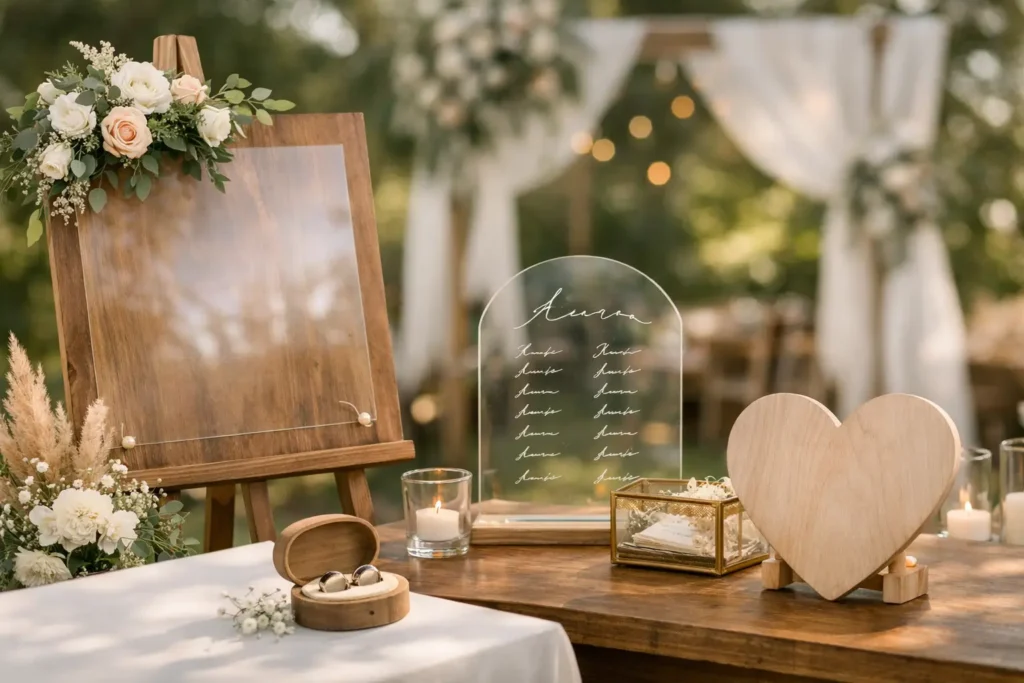
Clear acrylic, frosted acrylic and glass-effect signs suit contemporary spaces, hotel venues and couples looking for a clean, understated finish. They work beautifully with simple typography and can let flowers, foliage or the venue itself remain visible behind the wording.
The trade-off is readability. Clear materials need enough contrast between the text and the background. Place them against a calm surface rather than a busy wall or doorway, and avoid using very fine lettering for important information.
Keep wording warm and easy to read
Personalisation is what turns a sign into part of your wedding, but clarity should come first. Guests should be able to understand it at a glance, particularly at a busy entrance or across a reception room.
For a welcome sign, your names and date are usually enough. A short line such as “Welcome to our wedding celebration” feels friendly and timeless. If you want a more playful tone, make sure it still sounds like you. A favourite saying, a line from a meaningful song or a nod to your shared hobby can work well when it is brief.
Directional and information signs need plainer language. “Ceremony this way”, “Please sign our guest book” and “Cards and gifts” are direct, helpful and still easy to personalise with your chosen fonts and colours. Save elaborate wording for smaller decorative pieces where guests have time to pause and read.
Be careful with tiny script fonts. They can look lovely in a close-up photograph but become difficult to read in a dim room or from a few steps away. A good approach is to pair a decorative font for names with a simple, clear font for details such as times, table numbers and directions.
Make the seating plan work hard
A seating plan is one of the most useful custom wedding signs at any reception, especially when it is designed around the way guests will look for their names. Alphabetical lists are easy to scan, while lists arranged by table feel more traditional and can suit smaller guest numbers.
Check every name carefully before ordering. This includes spelling, preferred names and any titles you plan to use. Ask a trusted friend or family member to proofread it too. It is surprisingly easy to miss a typo when you have read the same list many times.
If your table plan is final only shortly before the wedding, consider where flexibility matters. Individual table numbers and place names can be easier to update than a large fixed plan. On the other hand, if your guest list is settled, a coordinated seating board makes a strong focal point at the reception entrance.
Add personal details without clutter
The most memorable wedding signage often includes small details that feel specific to the couple. Table names might be based on favourite places, films, flowers, pubs you have visited or places from your relationship. A drinks sign can feature a signature cocktail named after a pet. A memorial sign can honour loved ones in a quiet, respectful way.
These touches work best when they support the atmosphere rather than compete for attention. Choose one or two ideas that genuinely mean something to you. If every item has a different theme, font and colour, the overall effect can feel busy. Repeating the same names, date, materials or typefaces will help everything feel connected.
You can also think beyond the reception room. Personalised signs for the wedding morning, a reserved-seat plaque for close family, a small sign for a sweet table or a message beside your guest book all create lovely photo opportunities. They do not need to be expensive to feel thoughtful.
Order early and check the practical details
Custom pieces take a little more planning than off-the-shelf decorations. Finalise the wording before you order, including capital letters, punctuation and the date format. In the UK, it is usually clearest to write dates as 14 August 2026 rather than using numbers that could be read in different ways.
Measure the space where the sign will sit. A large welcome board needs an easel or a secure surface, while small table signs need to leave room for flowers, candles and serving dishes. Ask your venue what they provide and whether they have any restrictions on hanging items, candles or display stands.
Allow time for delivery and for checking your order once it arrives. Ordering ahead means there is room to deal with a last-minute guest-list change or simply to enjoy the final weeks before the wedding with fewer jobs on the list. Bespoke Engravers offers personalised keepsakes and practical wedding details designed to bring that individual touch within reach.
A well-made sign should not feel like another item to tick off. It should welcome the people you love, point them in the right direction and, after the day, remind you of the celebration you created together.
